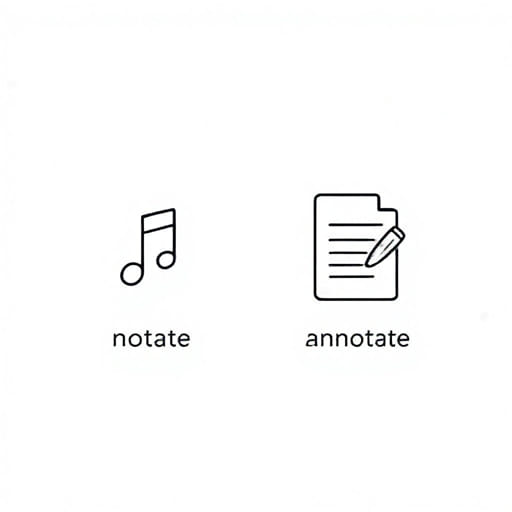
In the English language, it is common to encounter words that seem similar but serve distinct purposes depending on their usage, tone, or context. Among such pairs are notate and annotate. Although both words involve writing or marking information, they differ in meaning, application, and intent. Understanding the difference between notate and annotate is especially useful for students, researchers, musicians, and professionals who frequently deal with written or symbolic forms of communication. In this topic, we will explore the nuances, definitions, uses, and examples that highlight the distinction between these two important verbs.
Definition of ‘Notate’
What Does ‘Notate’ Mean?
The verb notate means to write down or record information using a system of symbols, often with the goal of preserving or communicating technical details clearly. It is most frequently used in specific fields such as music, dance, linguistics, or mathematics, where formal systems of symbols are essential.
Examples of Using ‘Notate’
To make the concept of ‘notate’ clearer, here are a few examples:
- The composer notated the melody using traditional sheet music.
- In phonetics class, students learn how to notate the pronunciation of words using the International Phonetic Alphabet.
- The choreographer notated the dance steps so they could be recreated later.
Context and Usage of ‘Notate’
Notate is technical and usually limited to situations that require a strict system of notation. It implies precision and adherence to a structured method. It is not typically used in everyday note-taking or casual writing.
Definition of ‘Annotate’
What Does ‘Annotate’ Mean?
Annotate means to add explanatory notes, comments, or critical observations to a text, image, or document. The goal of annotation is to enhance understanding, clarify meaning, or provide personal or scholarly insights. It is a broader and more accessible term used in academia, reading, software development, and other fields.
Examples of Using ‘Annotate’
Some illustrative uses of the term annotate include:
- The student annotated each paragraph of the poem with personal reflections and historical context.
- Scientists often annotate research papers to explain key findings.
- In the margin of the book, she annotated important themes and symbols.
Context and Usage of ‘Annotate’
Unlike notate, which is limited in scope, annotate can be used in both casual and academic settings. Annotations are not restricted to a specific symbolic system. They can be handwritten notes in a book, comments in a software code, or pop-up insights in digital media. The tone of annotation is often reflective, explanatory, or analytical.
Key Differences Between Notate and Annotate
Focus and Function
The primary difference lies in the purpose and context:
- Notatefocuses on transcribing something into a standardized symbolic format (like music or dance).
- Annotatefocuses on adding insight, commentary, or explanation to help the reader or viewer understand the material better.
Field of Use
The words also differ based on where they are commonly used:
- Notate is technical and used in specialized fields like music, linguistics, and choreography.
- Annotate is used in education, literature, science, and software development.
Formality and Frequency
In terms of how often and where these words appear:
- Annotate is more common in general writing, education, and everyday communication.
- Notate is less frequently used and often appears in professional or academic contexts requiring specialized skills.
Examples in Real Life Contexts
Academic Setting
In a literature class, students might annotate a Shakespearean sonnet to explore metaphors, wordplay, and tone. They would not notate the text unless they were transcribing its rhythm using scansion symbols in poetry.
Musical Composition
A composer working on a symphony would notate the music on a staff using notes, clefs, and time signatures. Later, a music critic might annotate the same score to explain why a certain phrase evokes emotion.
Software Development
Programmers often annotate their code with comments that describe what each section does. This helps other developers understand the logic. They do not notate code unless developing a visual diagram using formal symbols to represent system behavior.
Historical Research
When analyzing historical documents, researchers might annotate margins with translations, cultural references, or alternative interpretations. Again, the term notate would be inappropriate unless describing the exact transcription of a historical script.
Tips for Choosing the Right Word
Use ‘Notate’ When:
- You are dealing with formal systems of representation like music notation, mathematical formulas, or choreography.
- The focus is on recording precise symbolic information.
- The context is technical or academic with defined structures.
Use ‘Annotate’ When:
- You are adding commentary, explanation, or clarification.
- The context involves reading, coding, teaching, or analyzing content.
- You aim to provide insights, either for yourself or others.
Grammatical Forms
Both notate and annotate are regular verbs and can be conjugated in standard ways:
- Notate notates, notated, notating
- Annotate annotates, annotated, annotating
Their noun forms also differ:
- Notate â Notation
- Annotate â Annotation
Although ‘notate’ and ‘annotate’ may sound alike and both involve the act of writing or marking, they fulfill very different roles. Understanding the difference between notate vs annotate helps writers, researchers, musicians, and students choose the correct word for the correct situation. Notate is technical, precise, and tied to symbolic systems, while annotate is analytical, interpretive, and meant to add depth. Recognizing these distinctions will enhance both written and verbal communication and ensure clarity across a variety of fields.