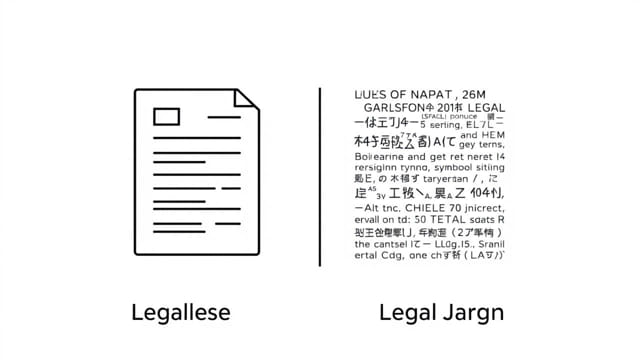
In the legal field, two commonly used terms legalese and legal jargon are often confused or used interchangeably. However, there are key distinctions between the two, and understanding their differences is important for anyone interacting with legal texts. These terms refer to specific types of language used in legal writing, but they serve different purposes and have distinct effects on how the law is interpreted, understood, and applied. Legalese and legal jargon can both be barriers to comprehension for the average reader, and each term has its own history, context, and implications in legal communication.
Definition and Characteristics of Legalese
What Is Legalese?
Legalese is a style of writing traditionally used by lawyers and legal professionals that is characterized by long, complex sentences and archaic expressions. It often includes passive voice, redundant phrases, and formalistic structures that are difficult for non-lawyers to understand. The term ‘legalese’ is often used critically, implying that the language is unnecessarily complicated and inaccessible.
Examples of Legalese
- The party of the first part shall hereinafter be referred to as…
- Notwithstanding anything to the contrary contained herein…
- Heretofore and hereinafter…
These types of phrases are commonly seen in contracts, deeds, and formal pleadings. Legalese evolved from a desire for precision and tradition in legal documentation, but over time, it has been criticized for hindering clarity and public understanding.
Understanding Legal Jargon
Definition of Legal Jargon
Legal jargon refers to specialized terminology that is specific to the legal profession. Unlike legalese, which focuses on the writing style, legal jargon consists of technical terms with precise meanings. These words and phrases are often necessary to describe legal concepts and procedures accurately. However, without proper explanation, legal jargon can also alienate or confuse people unfamiliar with legal systems.
Common Legal Jargon Terms
- Tort a civil wrong that causes harm and can lead to legal liability
- Habeas corpus a legal action to seek relief from unlawful detention
- Prima facie based on first impression; accepted as correct until proven otherwise
- Stare decisis the legal principle of determining points in litigation according to precedent
Legal jargon is essential in courtrooms, statutes, and academic law. It helps convey exact meanings that may not be easily translated into everyday language. While it may be confusing to outsiders, it is often indispensable within legal circles.
Legalese vs Legal Jargon: Key Differences
Style vs Substance
The primary difference between legalese and legal jargon lies in their function. Legalese refers to the stylistic manner in which legal documents are written, often unnecessarily verbose or outdated. Legal jargon, on the other hand, refers to content-specific terms used to describe legal concepts or actions with accuracy.
Accessibility
Legalese is widely criticized for making legal documents inaccessible to the general public. Its complicated structure and use of obscure phrases often require a legal professional to interpret. Legal jargon, although technical, can be translated or explained more easily once the definition of the term is known. Legal jargon is usually essential to the practice of law, while legalese is often seen as avoidable or obsolete.
Purpose and Use
Legalese is used more in formal writings such as contracts, wills, and deeds, where tradition and formatting play a big role. Legal jargon is used across all areas of law, including litigation, legislative drafting, and scholarly writing. While legalese can often be removed in favor of plainer language, legal jargon is usually indispensable because of its specificity.
Efforts Toward Plain Language in Law
Plain Language Movement
In recent years, there has been a growing push for plain language in legal documents. Many courts, legal institutions, and advocacy groups have recognized that overly complicated legal writing creates unnecessary barriers for people trying to understand their rights, obligations, and the legal system itself. Plain language involves replacing both legalese and overly complex jargon with clear, concise alternatives whenever possible.
Examples of Simplification
- Replacing hereinafter referred to as with called
- Changing notwithstanding the foregoing to even so
- Using you must instead of you are hereby required to
While some legal jargon must remain for precision, plain language advocates encourage legal writers to limit legalese and define jargon when used.
Why the Distinction Matters
Clarity for Clients and the Public
Understanding the difference between legalese and legal jargon helps in evaluating the clarity of legal communication. Legal professionals have a responsibility to ensure that clients can understand documents that affect their rights. Knowing when complex language is necessary and when it is not is a skill that enhances trust and comprehension.
Better Legal Drafting
By reducing legalese and appropriately using legal jargon, lawyers and legislators can draft clearer laws, contracts, and legal opinions. This improves legal outcomes, reduces litigation caused by misunderstandings, and promotes justice by making the law more accessible to everyone.
In summary, legalese and legal jargon serve very different functions in legal writing. Legalese refers to the overly formal and often outdated style that can obscure meaning, while legal jargon refers to necessary technical terms that convey precise legal ideas. Understanding the legal definition and implications of both terms is essential for legal professionals, students, and the general public alike. As the legal community continues to evolve, there is a growing movement toward clearer, more understandable language in law something that depends on properly identifying and minimizing the use of unnecessary legalese while maintaining the integrity of legal jargon where it is truly needed.